




A wet pool surround is one of the most underestimated hazards in a summer home. A child steps out of the water and crosses the terrace at a run, and on polished marble or natural stone that has turned slick, a fall can follow in an instant. Poolside slips are among the most common accidents of the season on the Costa del Sol, and on hard stone the consequences are rarely minor. The surfaces that give a pool area its elegance are frequently the same ones that become dangerous the moment they are wet.
The reassuring reality is that this is among the simplest risks in the home to resolve, and it can be done without altering the appearance of the floor in any way.
Why elegant surfaces become dangerous
Polished marble, honed stone, porcelain and glazed ceramic share a single characteristic: a smooth surface that offers water nowhere to disperse and a bare foot very little to grip. The conditions of an ordinary summer day compound the problem. Sun cream and body oils leave a fine residue, a thin film of algae can form in shaded and damp corners, and constant splashing keeps the whole area wet. Grip that felt entirely secure in the morning can disappear by the afternoon, and the change is easy to overlook until someone slips.
Who is most at risk
Anyone can lose their footing, but the consequences are not shared equally. Children move quickly, rarely look down and seldom recover their balance in time. Older guests and relatives are more likely to be seriously injured by a fall. And everyone who leaves the pool does so with wet feet, onto the most slippery part of the entire terrace. In a household with young children or elderly family members, the poolside is precisely where a modest and invisible precaution offers the greatest protection.
What an anti-slip treatment does
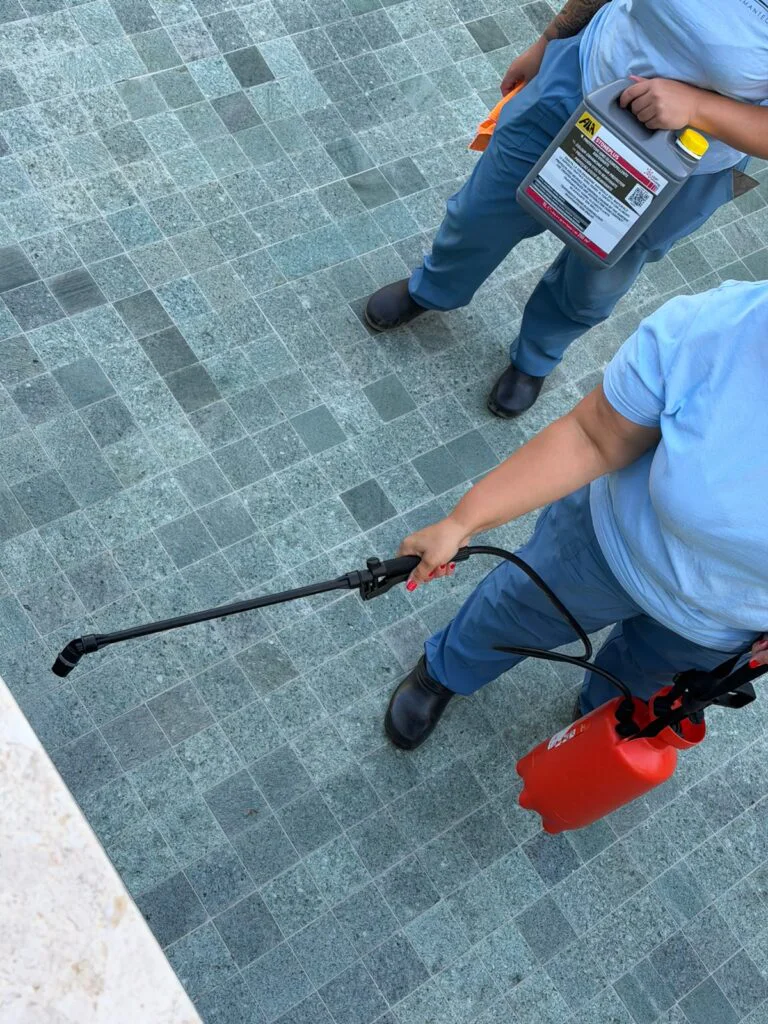
An anti-slip treatment increases the grip of a floor when it is wet, and it does so without leaving anything visible. Rather than forming a coating over the stone, it works at a microscopic level, creating a fine texture within the surface that allows water to disperse and gives the sole of the foot something to hold. When the floor is dry, it feels exactly as it did before. When it is wet, the improvement is immediate.
For this work we use FILAGRIP, the anti-slip treatment from FILA Surface Care Solutions, whose products we are certified to apply. It is designed for precisely this purpose: increasing the slip resistance of floors around pools, in bathrooms and on terraces while leaving their appearance untouched.
It preserves the look of your floor
This is the most common concern, and an understandable one. In a fine property the floor forms part of the design, and no owner wants a cloudy film, a change of colour or an artificial sheen over their marble. A correctly applied treatment produces none of these effects. There is no visible layer to peel, no shift in tone and no loss of finish. The marble continues to look like marble. The only change is in the way the surface performs underfoot when wet.
Where it is most valuable
The pool surround is the obvious priority, yet the same problem arises wherever water meets a smooth floor. Steps and staircases, indoors and out, are a frequent weak point, since a wet edge is easily misjudged. Bathrooms and wet rooms benefit equally, as do terraces, entrances and any threshold exposed to rain. Treating these areas together, in a single visit, is usually the most sensible approach, and it ensures the whole property behaves consistently underfoot.
Why it requires a certified applicator
Because the treatment alters the surface itself, the product and method must correspond exactly to the material. The correct approach for porcelain differs from that for soft marble, and an error can etch or dull a floor of considerable value. This is not work suited to experimentation.
Limantecon is the only certified applicator of FILA Surface Care Solutions in the region, as well as a certified distributor of the brand. Our team is trained by the manufacturer and applies these treatments regularly on the most valuable surfaces along the coast, and every project begins with a discreet test area, so the result can be seen on your own stone before the full surface is treated. It is worth adding that anti-slip is one of a broader family of floor treatments, and our guide to floor treatments explains how they relate to one another and how long each one lasts.
What the treatment involves
The process itself is straightforward and far less disruptive than owners tend to expect. After the discreet test, the surface is cleaned thoroughly, the treatment is applied and left to act for a controlled period determined by the material, and the floor is then rinsed and dried. Most pool surrounds are completed within a single visit, and the area can be used again shortly afterwards. There is no dust, no noise and no prolonged closure of the terrace, which matters a great deal when the work is carried out during a busy season. We also advise on the simplest way to preserve performance: a consistent, pH-neutral cleaning routine that maintains grip without harming the stone.
How long it lasts
A professionally applied anti-slip treatment performs for years under normal use. Its longevity depends principally on the level of foot traffic and the way the floor is cleaned. Acidic products shorten its life, so pH-neutral cleaners are the appropriate choice and protect both the treatment and the stone beneath. When grip gradually diminishes over time, the treatment can simply be reapplied, without disruption to the floor. During the assessment we provide a realistic estimate for your surface and the way it is used.
The ideal time to treat a slippery floor is always before, rather than after an accident. We would be glad to assess your surfaces and demonstrate the difference on your own floor. You can reach us on WhatsApp at +34 611 75 53 46, by email at info@limantecon.com, or at limantecon.com/en/contact.
Frequently asked questions
Will an anti-slip treatment change the appearance of my floor?
No. Applied correctly, it is entirely invisible. There is no coating, no change of colour and no loss of finish. The stone looks exactly as it did, and only the grip when wet is improved.
Is it safe for children and pets?
Yes. Once applied and cured, the surface is safe for everyone. Making wet areas safer for those most likely to slip is the purpose of the treatment.
Which surfaces can be treated?
Marble, natural stone, porcelain, ceramic and other smooth hard floors, whether around the pool, on steps, in bathrooms or on terraces. The product and method are matched to the specific material.
Is the floor slippery when dry?
No. The treatment improves grip when the floor is wet, which is when the risk is greatest. It does not leave the surface rough or uncomfortable underfoot when dry.
Do you test before treating the whole area?
Always. A small, discreet area is treated first, so the finish can be confirmed on your own stone before the work continues.