




Few regions in Europe reward solar power as generously as the Costa del Sol. With more than three hundred days of sun each year, a rooftop installation should be among the soundest investments a property here can hold. Yet many owners quietly lose a share of that return, and the cause is usually in plain view on the roof. A panel produces electricity only when light reaches it, and on this coast panels accumulate grime more quickly than almost anywhere else in Europe.
The output you are paying for and not receiving
A solar panel generates electricity when light passes through its glass to the cells beneath. Anything resting on that glass obstructs the process: a film of dust, a scattering of bird droppings, a crust of dried salt. Each one reduces the light reaching the cells and, with it, the energy produced. The loss is gradual and easily overlooked, which is exactly why it often goes unnoticed until the bills begin to rise. Regular cleaning can restore efficiency by as much as thirty per cent, and the effect is rarely uniform: a single stubborn deposit can shade an entire run of cells and reduce the output of the whole string. What appears to be a minor mark can represent a real and recurring cost.
A coast that works against your panels
Every location has its own particular sources of soiling, and those on this coast are more persistent than most. The calima carries fine Saharan dust that settles across the region and adheres to glass long after the skies have cleared. Proximity to the sea produces a constant film of salt, both corrosive and adhesive, which binds other particles to the surface. Spring adds a layer of pollen, nearby trees and birds contribute their share, and continual construction sends cement and road dust drifting onto rooftops. All of it accumulates on the one surface that must remain clear.
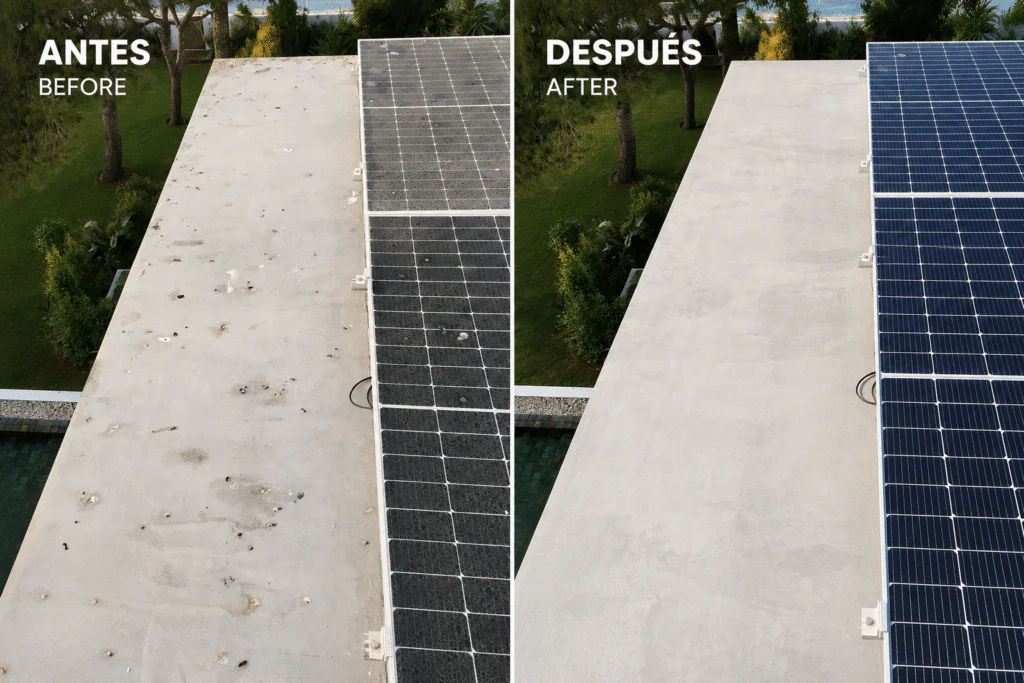
Why rain is not enough
It is tempting to rely on the first rainfall to do the work. It will not. Rain runs off the glass and leaves its mineral content behind as streaks and spots, and in a region of hard water and heavy dust it tends to concentrate soiling along the frame and lower edge rather than removing it. Relying on the weather to clean a solar installation is one of the most common assumptions an owner makes, and one of the most costly.
How often panels should be cleaned here
There is no single figure, as much depends on the location of the property. As a general guide, most installations on the coast benefit from cleaning two to four times a year, more frequently for properties close to the sea, a busy road or open countryside, and an additional clean is always advisable after a significant calima.
A proper assessment considers far more than the visible dust. It takes account of the angle and accessibility of the array, the surroundings that contribute to soiling and the recent weather, and establishes a schedule that maintains output without cleaning more often than necessary. That balance is what protects the return: sufficient to preserve performance, and never more than the installation requires.
Why professional cleaning is worthwhile
Cleaning a panel correctly bears little resemblance to cleaning a window. The glass carries a delicate anti-reflective coating that abrasive pads and household detergents can damage, and the array is a live electrical system, typically mounted on a roof. Performed properly, the work uses purified water that dries without leaving a mark, soft brushes that will not scratch, and no aggressive chemicals. A trained technician also identifies issues that an untrained eye would miss: a loose fixing, a damaged cell, or shade that has gradually encroached as vegetation has grown.
The return is straightforward to weigh
The economics are simple to assess. An installation losing even a fraction of its output to soiling recovers that ground as soon as it is cleaned, and on a coast as bright as this the regained generation accumulates quickly. Weighed against the modest cost of a professional visit two or three times a year, the return is seldom in doubt. On the larger arrays found on villas, communities and commercial buildings, where a single percentage point represents a meaningful sum, the case is more compelling still. Few maintenance tasks recover their cost as reliably within the same season.
A clean and an inspection in one visit
There is a further advantage to a professional service. While the panels are being cleaned, they are also being inspected. A technician on the roof will notice wiring loosened by the wind, a clip beginning to lift, a developing micro-crack, or a branch now casting a shadow across part of the array in the afternoon. Identifying such issues early is considerably less costly than discovering them when an entire string ceases to produce. The result is a clean installation and a clear understanding of the system’s condition.
We clean solar installations as part of our industrial and property maintenance across Marbella and the wider coast, using professional Kärcher equipment and the appropriate method for the task. The results are measurable: one client recorded a twenty-eight per cent increase in output following a single professional clean, a return that repays the service many times over.
The false economy of doing it yourself
Cleaning the panels personally introduces two risks at once: to your own safety, on a wet and sloping roof, and to the panels themselves. Tap water dries into limescale, an unsuitable brush scratches the coating, and misapplied pressure can force water past the seals or crack a cell. Some manufacturers regard improper cleaning as grounds to void the warranty. The saving is modest, and the potential cost is not.
If you would like to know how much your installation is truly producing, we would be glad to assess it and restore it to full efficiency. You can reach us on WhatsApp at +34 611 75 53 46, by email at info@limantecon.com, or at limantecon.com/contacto.
Frequently asked questions
How often should I clean my solar panels on the Costa del Sol?
Most installations here benefit from cleaning two to four times a year. The appropriate frequency depends on proximity to the sea, roads or open land, and on recent calima. An assessment provides an accurate answer for your roof.
Does rain clean solar panels?
No. Rain runs off and leaves mineral deposits as streaks and spots, and in a dusty region with hard water it tends to concentrate soiling along the edges rather than removing it.
Can I clean them with tap water?
It is not advisable. Tap water leaves limescale as it dries, which reduces output. A professional clean uses purified water that leaves no residue, together with soft brushes that protect the coating.
Does cleaning genuinely improve output?
Considerably. Regular cleaning can improve efficiency by up to thirty per cent, and one client recorded a twenty-eight per cent increase after a single clean.
Do you offer solar panel cleaning on the Costa del Sol?
Yes. We clean solar installations across Marbella and the wider coast as part of our industrial and property maintenance, using the correct method for photovoltaic glass.